🦾 Vox Next Gen — Industrial AMR Prototype
Vox Next Gen is my Master's dissertation project: a ground-up evolution of my Bachelor's thesis robot, Vox, rebuilt as a low-cost autonomous mobile robot (AMR) prototype for indoor navigation. It's designed as a demonstrator for internal industrial logistics applications, with a new 3D-printed enclosure and a differential-drive chassis (two driven wheels and a passive caster), controlled by a Raspberry Pi 4.
Obstacle avoidance runs on sensor fusion across four HC-SR04 ultrasonic sensors (front, right, rear, left, interfaced through an Arduino Uno), combined with a computer-vision pipeline using the YOLOv8n neural network and Haar-cascade face detection. The core technical contribution is a stuck-detection algorithm that monitors the variance of all four range readings over time, recovering the robot from blind-spot entrapments between sensor coverage zones that no single sensor can detect on its own.
Two KY-003 Hall-effect wheel encoders and an MPU6050 IMU feed a dead-reckoning odometry system that enables voice-commanded room mapping: the robot can be taught named locations ("remember this as the kitchen") and later navigate to them on request ("go to the kitchen"), with its estimated position and saved rooms shown on a live web-based house map alongside an MJPEG video stream with real-time detection overlays. Voice interaction combines fully local, offline speech transcription (Vosk, adopted after a cloud Whisper service was found to hallucinate words from ambient noise), an LLM-based conversational agent (Llama 3.1 via the Groq API), and local text-to-speech (espeak) — supporting movement commands, mapping commands, and open dialogue through the robot's own microphone or a browser-based phone interface.
Validation combined repeated real-world obstacle/entrapment testing, qualitative detection review, and instrumented odometry measurement against a physical route. A genuine hardware fault in the left-wheel encoder (two of four magnets non-functional) was found and fixed during testing, cutting distance-estimation error from roughly 54% to about 8%. The dissertation also lays out a scaling path toward a full industrial AMR — proper SLAM, rigorous instrumented validation, WMS/MES integration, additional sensing, and multi-robot fleet coordination.
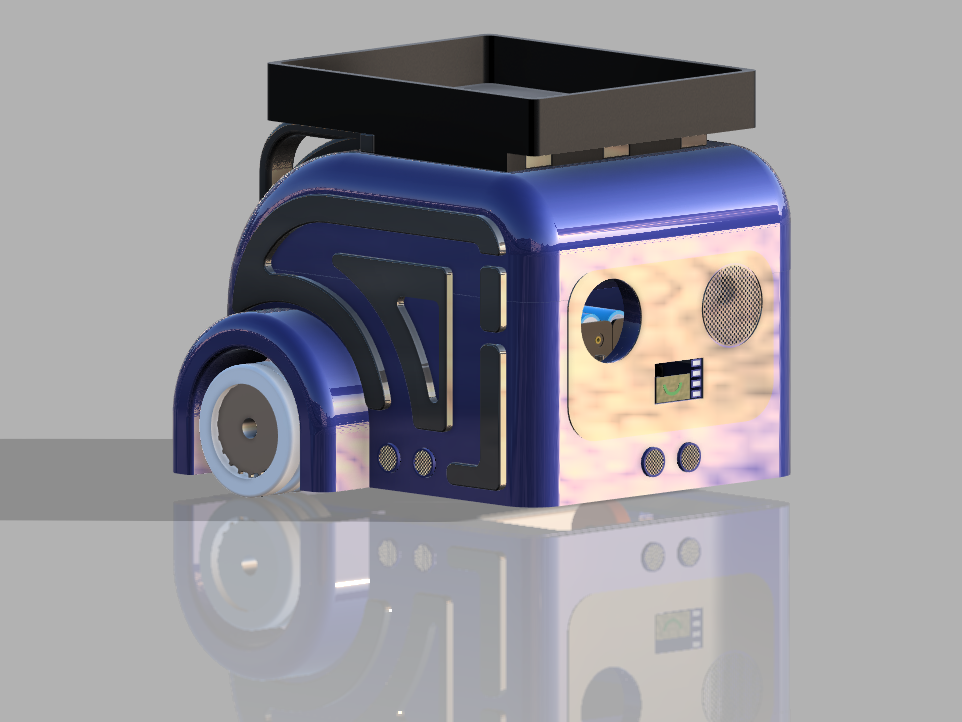
Enclosure render.
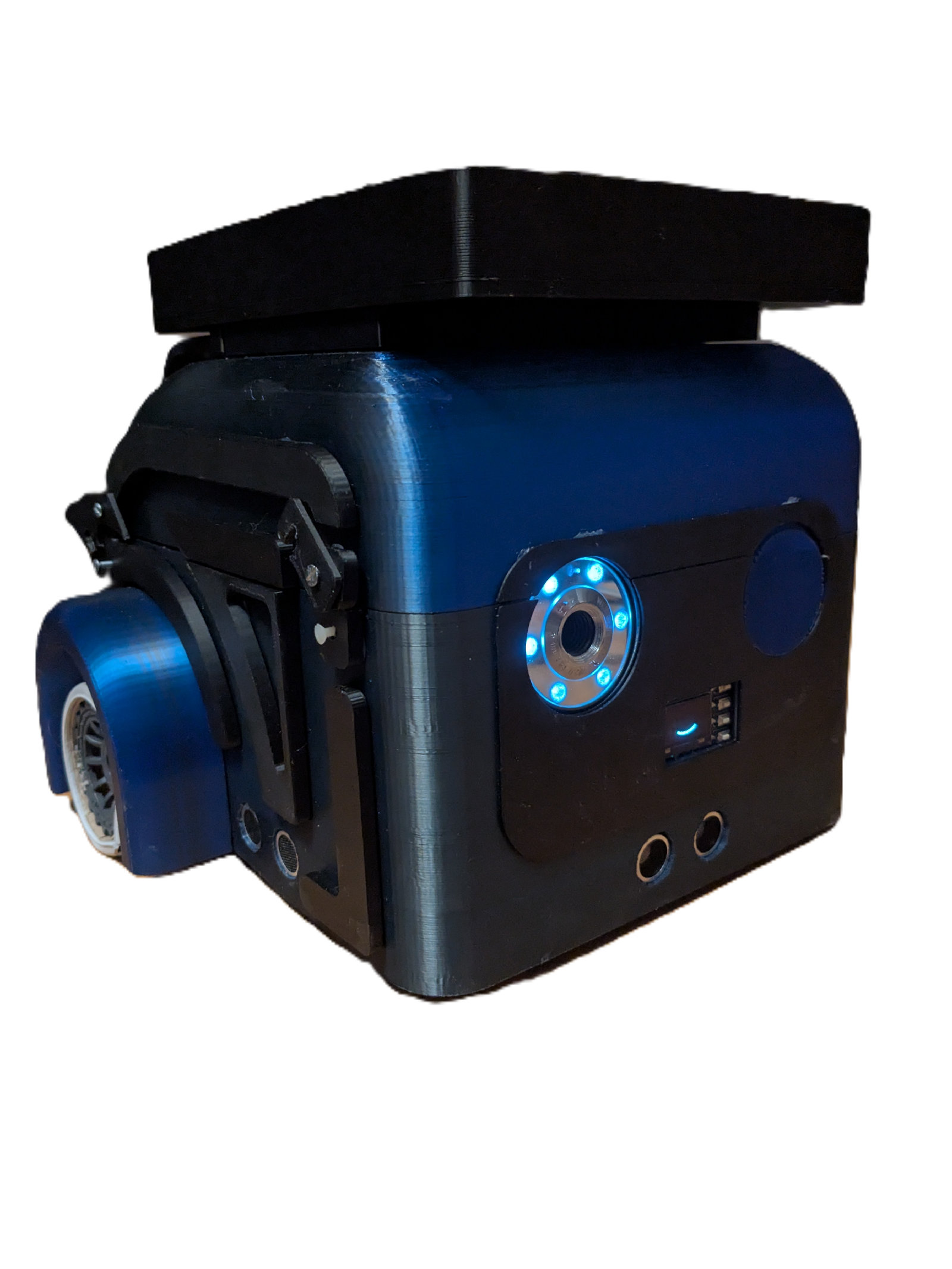
The built physical prototype.